

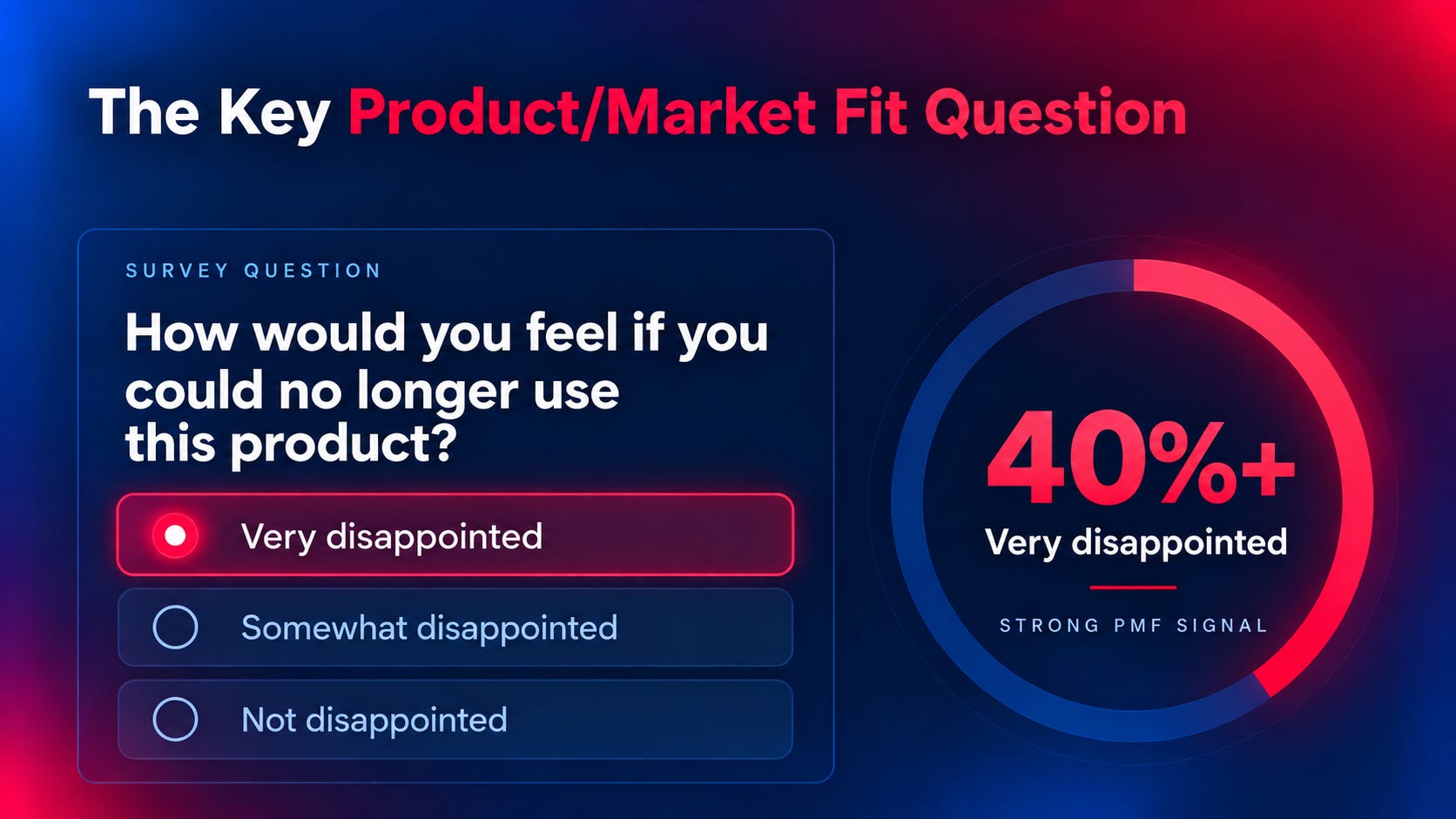
I often hear from founders who are confused by conflicting product/market fit signals. They run my product/market fit (PMF) survey and more than 40% of respondents say they would be “very disappointed” if they could no longer use the product. Based on this 40% benchmark I established years ago, they understandably believe that they have achieved product/market fit. But then they look at retention cohorts and notice that they continue to trend toward zero. In other words, for every 100 new people they acquire, eventually all of them stop using the product.
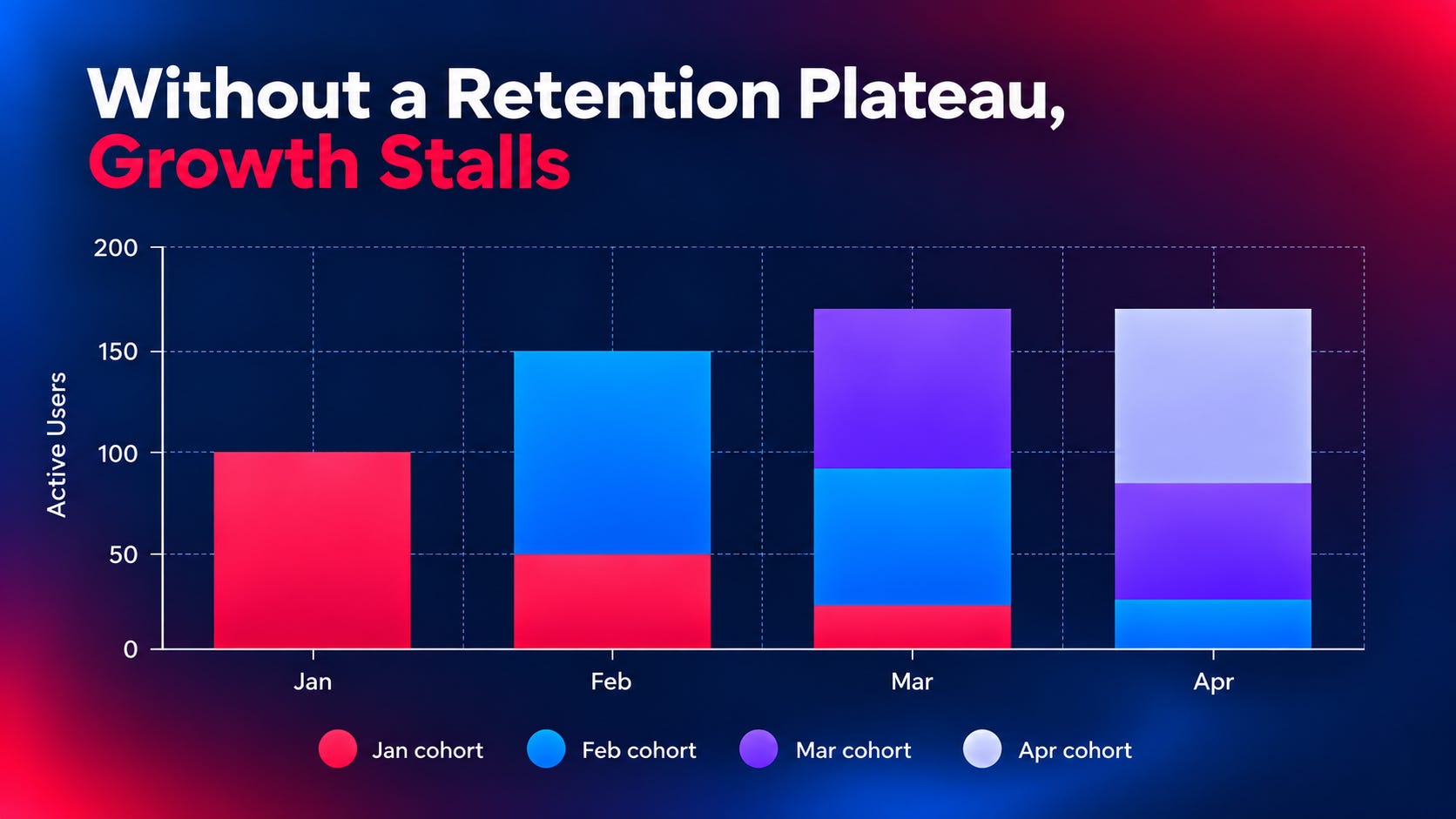
Without a retention plateau, growth will not compound. Eventually all newly acquired users are simply replacing the ones that are churning.
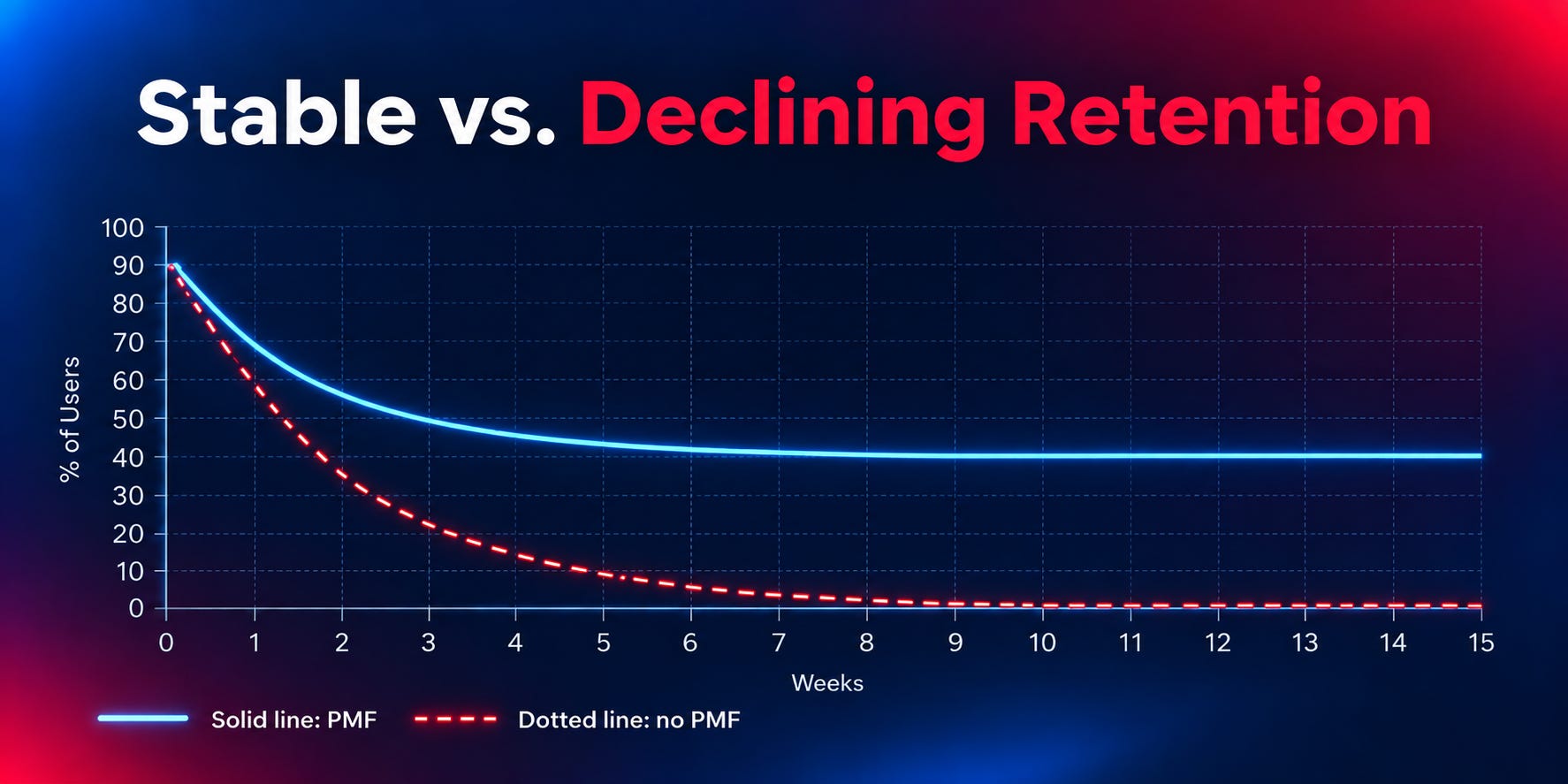
I initially developed the PMF survey as a shortcut to help me gauge if PMF exists. At the time, tracking retention cohorts was beyond the capabilities of most early stage startups. But ultimately real user behavior is much more important than what users say in a survey. So does this mean that a lack of plateauing retention cohorts automatically means you don’t have PMF? Not necessarily.
The good news is that if you have a strong PMF Survey score (above 40%), it is very likely that you will be able to find a cohort of users with strong long term retention. Sometimes this only requires changing how you measure retention. Other times, it requires a much deeper search to identify the specific users, use cases and activation experiences where product/market fit actually exists.
Most Common Reason for High PMF Score and Weak Cohort Retention
The most common cause of a strong PMF survey score without a plateauing retention cohort is an error in how retention is being measured. For example, if your starting event in a cohort report is a signup, it’s very likely that you will not see a plateau in the retention curve. Not enough people who sign up experience enough value to want to keep using your product.
Instead try to use a starting event in your cohort report that is tied to a valuable experience with your product. The ideal experience will be one that many people reach and that delivers enough value that many of those users come back for more. In growth we often refer to this as an “aha moment” or reaching an activation experience.
If changing the starting point of the retention cohort reveals a healthy plateau, then you may have already solved the mystery. The survey was asking people who had experienced meaningful value how they felt about the product, while the original retention cohort included too many people who never really experienced that value in the first place.
But sometimes even a properly constructed retention cohort continues to decline. At that point, I start looking at another common source of conflicting signals: how the survey itself was collected.
Who Should You Ask?
The quality of the PMF survey depends heavily on who you ask. I generally recommend surveying a random sample of people who have used the product within the last couple of weeks and have reached an activated state. There is little value in asking someone who signed up but never experienced the core value of the product how they would feel if they could no longer use it.
When possible, I prefer emailing the survey because it tends to give you a more random sample of these recently activated users. Not everyone will respond, but everyone in the selected sample has a similar opportunity to receive and complete the survey.
Mobile apps create a different challenge. People generally do not respond very well to email surveys for mobile products, so I often recommend an in-product survey prompt instead. This usually generates many more responses, but it introduces an important bias. Your most active users are naturally the people most likely to open the app and see the survey prompt. Since they are already the most active users, they are also more likely to consider the product a must-have.
This can push the “very disappointed” percentage higher than it would be with a more random sample. I think that is perfectly acceptable as long as you understand the bias and do not treat the headline score as precise proof of product/market fit.
In fact, having more must-have users complete the survey can be a big advantage. The most valuable part of the PMF survey is not simply calculating the percentage of people who would be very disappointed without the product. It is deeply understanding those must-have users. What benefit are they getting from the product? Why is that benefit important to them? What do these users have in common?
So if an in-product survey produces a somewhat biased sample but gives you a large group of must-have users to study, I generally consider that useful. It simply means that you may need to do more digging before concluding that you have broad product/market fit.
Going Beyond the Simple Solutions
Often changing the way you measure retention cohorts and accounting for survey bias will give you a clearer reading of PMF. But if that doesn’t resolve the conflict, you may need to do a more rigorous search for where the fit actually exists. Again, if you have a strong PMF survey score, there is a good chance you’ll find it if you look hard enough.
For example, I worked with one startup where only 7% of early users considered the product a must-have. The startup, Lookout, offered a suite of mobile security features including firewall, backup and antivirus. But when we ran the survey, we learned that the must-have users were focused on the antivirus benefit. So we repositioned Lookout around antivirus and streamlined onboarding around that use case. The next cohort of users who signed up reached a 40% PMF score. These changes only took about two weeks to diagnose and implement.
Searching for Product/Market Fit
I’ve increasingly come to think of product/market fit as something that you search for rather than simply measure. The overall survey score and retention curve are both useful signals, but averages can hide the most important insights.
The first thing I look for is the right user segment. Must-have users may be concentrated around a particular role, company type, level of experience, geography or another characteristic. If one group of users is retaining dramatically better than everyone else, combining them with the rest of the user base can hide the fact that strong product/market fit already exists for that segment.
Next I try to understand the use case that makes the product important. Two users who look almost identical in your analytics may be using the product for completely different reasons. One may consider it a nice convenience while another is using it to solve an important recurring problem.
This is where the follow-up questions in the PMF survey become particularly useful. I want to know what primary benefit the must-have users receive from the product and why that benefit is important to them. Their answers often reveal a more compelling use case than the one the company has been emphasizing.
Finally, I look for the activation experience that separates people who retain from those who don’t. What did the retained or must-have users actually do before they began consistently getting value from the product?
Many companies define activation around completing onboarding, creating an account or using a feature once. But these events may have little relationship with long-term retention. I am much more interested in finding an early behavior that has a strong relationship with users continuing to receive value over time.
Finding the right activation event or aha moment is one of the biggest challenges a growth team faces. But getting this right can be a critical key to unlocking long-term growth. I often spend months experimenting with different activation ideas while working across the broader growth function. I generally start with what intuitively makes sense. When do I think a new user has experienced the product enough to really “get it?” There is no perfectly right answer for choosing your aha moment, which is why it makes sense to keep searching for a better one.
Beyond activation, you’ll also want to study different user segments, use cases and other patterns. You want to find the type of user that continues to come back and get value, and understand how that user first experienced that value.
Now you have something much more valuable than simply knowing that 42% of survey respondents would be very disappointed without your product. You have a hypothesis for where product/market fit actually exists, for whom, and why.
Validating What You Find
Once you develop a strong hypothesis for where your PMF exists, the next step is to validate it. I would try to acquire more people who match that user type and highlight the relevant use case and associated benefit. Then I would obsess on getting as many of those people as possible to experience my best guess at the aha moment.
Now you can track this new cohort from the activation event and see what happens to their longer-term retention. If these users consistently plateau, you now have much stronger evidence that you have found real product/market fit. More importantly, you understand the drivers behind it.
Once you really understand your product/market fit, you can sustainably drive growth by leveraging it. You know which users you should be targeting, what promise is most likely to resonate with them while still reflecting the must-have value, what experience they need to reach quickly and what value the product must continue delivering.
Instead of trying to improve growth across an overly broad user base, you can concentrate your resources around the people and use cases where your product already matters most.
For companies scoring above 40% on the PMF survey but struggling to find a plateauing retention cohort, I would therefore consider the survey result encouraging rather than contradictory. First make sure you are looking at the right retention cohort and understand any bias in how your survey was collected. If those simple explanations don’t resolve the discrepancy, search the data more aggressively.
And even if your overall PMF score is well below 40%, I wouldn’t ignore the users who say they would be very disappointed without your product. Sometimes that relatively small group of must-have users contains exactly the clues you need to identify the right segment, use case and activation experience.
Product/market fit may not be something you still need to create from scratch. It may already be hiding in your user base.
Nice article. For me, a lack of user retention tells me the product is targeting the wrong ICP. If you can find the right ICP and iterate the product to better align with their needs retention should improve.
Super helpful thanks for sharing